



Using Lasers in Curling
This article is joint work with John Newhook of Dalhousie University.
In curling, a point, or “dot”, laser is (nearly) essential to the setup of several drills, most commonly the “gauntlet drill”. In the gauntlet drill, the laser acts as the “target broom” to which the athlete throws their stone, and at the same time the laser shines a “dot” on the striking band of the stone so that it is much easier to observe lateral movement in the stone during the delivery. In this article, we explore the several different types of commercial lasers available and describe their use on the ice.
Lasers, or Light Amplification by Stimulated Emission of Radiation, are devices that emit radiation on a narrow wavelength band, which means the laser forms a concentrated, pencil-like beam that can cover considerable distances. In a curling context, we are interested in lasers that emit wavelengths of visible light. The wavelength of light in lasers is usually measured in nanometres (nm), or one-billionth of a metre. Regular, visible-light lasers that you can purchase commercially are either red (wavelength between 630 and 670nm), green (approximately 530nm), or blue (approximately 445nm), red lasers being far and away the cheapest and most common.
Lasers are categorized into classes based on their power output, measured in milliwatts (mW), which is one-thousandth of a Watt. Only very low-power lasers are safe for use by the public, as significant damage to one’s eyes is possible with higher-powered devices [1-3].
Under the International Electrotechnical Commission (IEC) Standard 60825-1, laser products are categorized in the following order, from the lowest to highest potential risk: Class 1, 1M, 2, 2M, 3R (sometimes labelled 3a or IIIa), 3B and 4 (see chart). To help reduce potential health risks, battery-powered hand-held lasers and laser pointers should be Class 3R/IIIa or less, and have a power output of 5mW or less. As in the United States, in Canada the sale or importation of class 3B or class 4 lasers is prohibited by law.
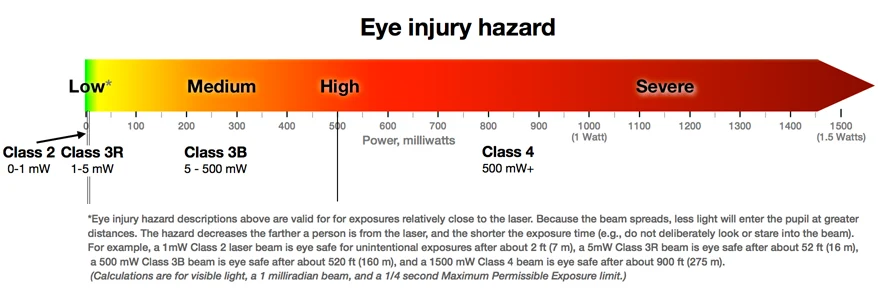
Most commercially-available lasers are Class 3R lasers, which emit less than 5mW and are safe to use if handled properly; others, such as those used in barcode scanners, are of even lower power and are Class 2.
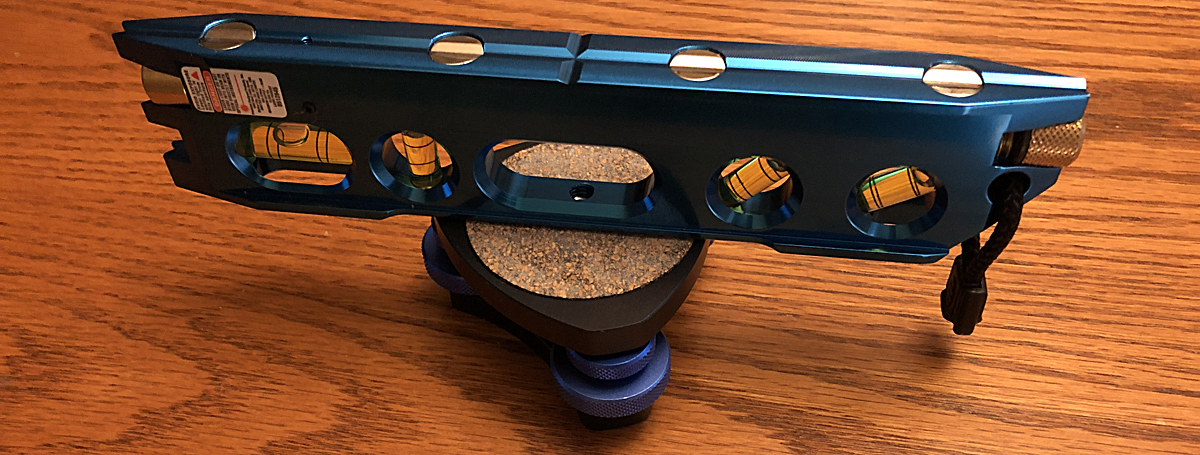
There are many types of “dot” or pinpoint lasers available. By and large, most low-cost lasers are designed for construction applications and emit a red light. In the photograph at the top of this article is a CheckPoint-brand 880-G3 point laser, manufactured by Precision Design Products of Pacoima, California. Levels such as these are often termed “torpedo” levels and are used in construction applications.
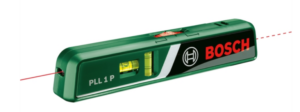
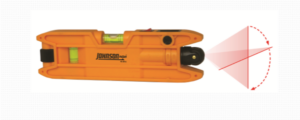
This particular model runs on three AAA batteries, emits a red light, has an accuracy of +/- 1/4 inch at 100 feet, and operates at a wavelength of 650nm. Other examples of inexpensive Class 3R “torpedo” levels are the Bosch PLL 1P (left) and the Johnson 40-0915 model, shown below. The Johnson model, which also emits a red light, operates at 635nm and uses two AAA batteries. Its accuracy is lower than the Checkpoint model, at +/- 3/8 inch at 50 feet, which is still quite accurate enough for use in curling. However, the Johnson laser has an effective operating range of 100 feet, meaning that its light may not be bright enough for use in a curling context, particularly in brightly-lit curling clubs.
With low-power lasers that have limited effective range, in brightly-lit curling clubs it may be difficult to setup the laser from the far tee-line and still properly adjust the laser’s alignment on a curling stone, simply because the laser light may not be bright enough. Two solutions present themselves for this problem: either dim the lights over your sheet of ice, or move the laser closer to the throwing end (say ½ the distance down the sheet). If the latter, it may be necessary to modify the drill and stop each thrown stone before it makes contact with the laser.
Green Light Lasers
Recently, relatively inexpensive green lasers have become available for commercial sale, though these are very difficult to find in retail outlets in Canada. All of the green lasers that we are aware of for commercial sale are intended as a “scope” for use on a rifle. Fortunately, some of these models are also low-power lasers operating at less than 5mW. Hence these lasers are classed as Class IIIa lasers and are safe for use by the public, though they will cause more eye damage than a red laser if used improperly and greater care should be taken with their use.
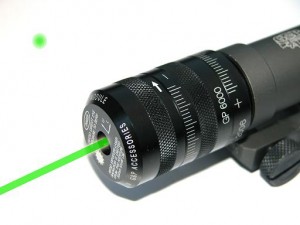
The main advantage of a green laser over one that emits red light is that green light is so much more visible to the human eye. Green is closer to the center of the visible spectrum, at approximately 530 nanometers, so it is much easier for our eyes to perceive the color in comparison to a red laser at 635 nanometers. With a green laser, you can still easily make out a visible beam in low-light conditions, and a green laser can appear as much as 50 times brighter than its red equivalent.
An example of a green rifle laser is pictured at left. This laser is available from Sporting Outback Supplies of Australia and operates at 532 nM with a power output of 5 mW. Other options include this Pinty model, available from Amazon, and this tactical laser sight from FOME, also available through Amazon. Both of these are also Class 3R lasers and legal for use in Canada.
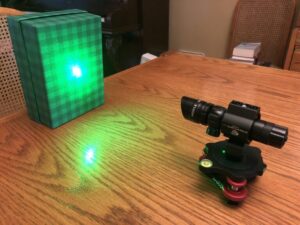
The model at right is a Class 3R WNOSH 532nm green light laser available from Amazon, also designed for use on a rifle. We are using a Streamlight flashlight helmet mount to hold the laser in place, and the helmet mount is screwed onto a 3/8-inch Andoer LP-64 three-wheeled tripod leveling base. The helmet mount, made of aluminum, has been re-tapped with a 3/8-inch 16 tap to fit the typical 3/8-inch, 16 threads-per-inch bolt used by a camera tripod mount. This combination offers excellent flexibility and is both compact and lightweight, and features a rechargeable battery.
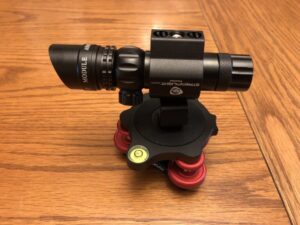
Unfortunately, laser models such as this designed for hunting come with mounts that are intended to fit on a rifle, pistol, or shotgun – they are not designed for use with a tripod base (see above and below) and so a customized mount, such as that described above, will need to be fabricated for use. While a green laser is brighter and more visible – a significant advantage in a brightly-lit curling club – the disadvantages of a green laser are (a) they consume more power than a comparable red-light laser, and (b) they tend to require a higher ambient operating temperature, for example, greater than 20 degrees Celsius, that may make them unsuitable for use in a curling context. Ensure you verify the specifications of any laser that you intend to purchase.
Leveling Bases
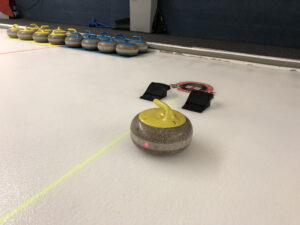
In the gauntlet drill, the laser is used to center a “dot” of light on the striking band in the middle of the curling stone, enabling analysis of LOD delivery faults. A leveling base, as seen here, is not absolutely essential, but does make adjustments in the height of the laser considerably easier to make. Ideally, the “dot” of the laser should fall onto the striking band of the stone, making the pinpoint of light easier to see. Note that a top-quality, expensive laser isn’t necessary. In fact, a slightly poorer-quality laser will make a slightly larger “dot” on the stone at a 126ft distance (far tee-line to hack), making video recording easier.
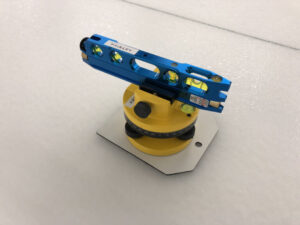
The photograph at left is of a Checkpoint 880-G3 torpedo laser, resting on an adjustable Stanley tripod mount head, designed for a Stanley torpedo level. The tripod base has three adjustable wheels to level the base in each orientation, making adjustments on the ice both simple and robust.
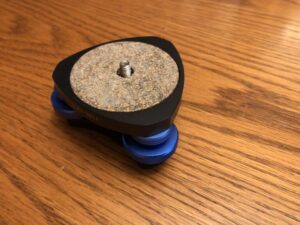
A similar leveling base are these Desmond-3814 models shown here, at right, available from Amazon, that are designed for placement on top of a camera tripod. These bases have a 3/8 inch tripod mount on the bottom and a 1/4-inch threaded bolt mount on the top – which precisely fits the 1/4-inch mounting hole in the bottom of a Checkpoint-brand torpedo laser. Along with a small insulator for placement on the ice, this combination offers excellent quality at a reasonable cost. The Desmond 3814 level is very lightweight and easily fits in a curling bag or backpack.
Usage
Levelling bases are almost always made of metal (often aluminum) and so can melt the ice surface if placed directly on the sheet. To prevent damage to the ice, an insulating layer is required. Often scoreboard numbers, especially if made of wood, can act as a reasonable insulator but a small square of 3/8-inch plywood is trivial to make and ensures one has a ready-made insulator at all times.
For both athletes and coaches, lasers usually sit idle during the summer months. May is the perfect time to remove the batteries from the unit and replace them with top-quality ones, so as to avoid battery leaks inside the unit.
Finally, we note that a small but significant percentage of athletes are colourblind, particularly men who frequently suffer from red/green colourblindness. For such athletes, neither the red nor the green light of a laser will be visible on a curling stone, since to red/green colourblind individuals both colours appear as similar shades of grey and will blend in completely with the grey colour of a stone’s striking band.
Safety
All lasers produce an intense, directional beam of light. The risk of skin damage with low-power lasers (Class 3R or lower) is extremely remote, but studies have shown that the human eye is much more susceptible to radiation damage in part because the cornea of the eye, unlike skin, does not have a layer of dead cells to protect it [1]. Moreover, retinal damage is possible with all classes of lasers, even ones with very low power output. The worst-case scenario is for a laser to directly enter the eye through the lens, where the laser’s beam will be focused onto the retina and concentrating the radiation energy by a factor of 100,000 when the focused beam strikes the retina. Even very short exposures of less than 0.25 seconds with a Class 3R laser is enough to cause significant, and permanent, retinal damage to the eye [1,2].
We strongly recommend the following safety guidelines and best practices when using lasers:
- Ensure that your laser device is a Class 3R (IIIa) laser or lower. In Canada, using any laser of higher power (greater than 5mW) requires mandatory, specialized training.
- Look for warning labels, safety features and instructions that explain how to properly handle the laser.
- Turn off any laser when it is no longer being used.
- Never point a laser beam at anyone.
- Never look directly at, or into, the beam emitted by the laser.
- Never aim a laser pointer at surfaces that would reflect the light back, like mirrors or mirrored surfaces. In the curling rink, ensure when setting up a laser that the beam remains very close to the surface of the ice.
- Never leave a laser within the reach of children. Do not allow younger children to handle lasers.
- If you are uncertain about the classification of a laser, contact the manufacturer or retailer.
- Never ‘play around’ with lasers, as they can be a fire hazard, cause flash-blindedness, or permanent eye damage.
Although Class 3R lasers are in common use in construction and in DIY household renovations, they are still lasers. Proper precautions and best practices should be exercised to avoid shining a laser at eye level. Remember, there may be other athletes on the ice, and there may also be players, coaches, or spectators behind the glass. Lasers should only be turned on when the direction and line of light are just above the ice surface. They should remain off at all other times.
Acknowledgments
We thank Jason Rice, P.Eng., for his comments on an earlier version of this article.
References
[1] Laser Institute of America (2019). Laser Safety Information. Available online from http://www.lia.org.
[2] Paulausky, C. (August 2014). Laser Safety: The Eyes Have It! Journal of Occupational Health and Safety 83(8), pp. 10-12. Available online, published by the Journal of Occupational Health and Safety.
[3] Rockwell, R. James Jr, William J. Ertle and C. Eugene Moss (August 1988). Safety Recommendations of Laser Pointers. Journal of Laser Applications 10(4), pp. 174-180. Published online by Rockwell Laser Industries.